

Clay plaster and bio board
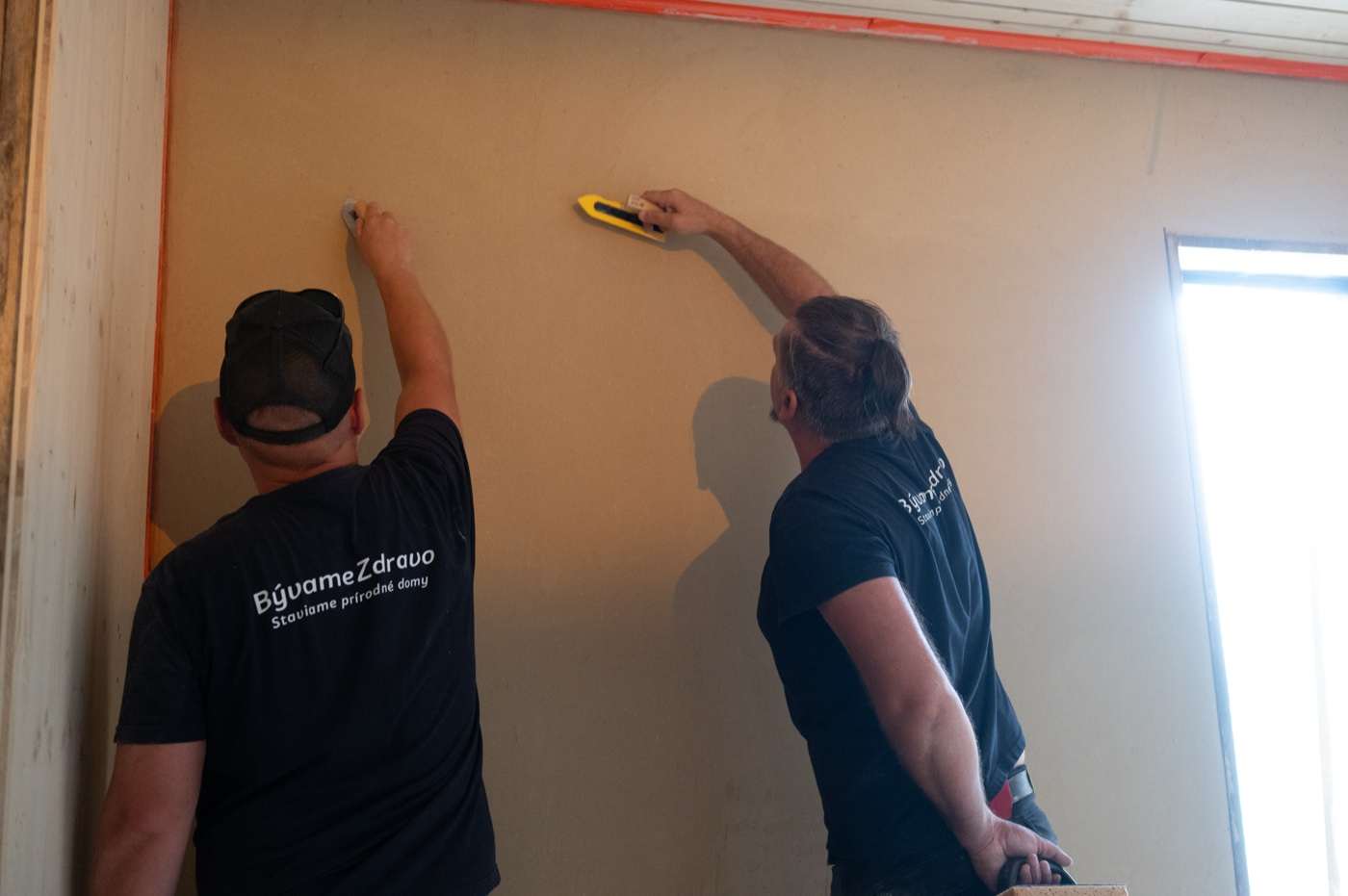
We cover interior walls with clay plaster or bio board. A typical prefabricated home has plasterboard, gypsum fibre board or plaster on board inside.
Two surface options
Clay plaster is 30 mm thick on the wall. We apply it by hand in the hall, while the module is still under a roof. On a straw wall the plaster goes directly onto the straw panel, in two layers: a base coat 20 mm thick and a fine coat 4 mm thick.
The other option is bio board, 19 mm thick. Both options sit on the service cavity, so the installations in the wall remain accessible.
What clay does with moisture
When there is a lot of moisture in the air, for example while cooking or after a shower, clay plaster absorbs some of it. When the air dries, it gradually releases the moisture back. It therefore dampens short-term swings in humidity, while ventilation sets the average humidity in the home. This only works if the plaster is not covered with a vapour-tight paint.
Clay holds heat
Plaster 30 mm thick is heavy and warms up and cools down slowly. In winter it keeps heat in the room longer, and in summer it softens rapid overheating. In the home in Nižný Klátov there are heating mats in the plaster, and heat radiates directly from the wall.
Repair with water and clay
Clay plaster hardens by water evaporating from it. Marek explains it simply in the video (in Slovak): if you add water to it again, even after years it is the same material. A scuffed edge or a nail hole can therefore be filled with dampened clay, and the mark of the repair disappears.
For the same reason the plaster can be returned to nature at the end of the home’s life. Cement plaster hardens chemically and cannot go back.
Handwork
Craftsmen plaster each wall by hand, so it has a fine texture and no two walls are the same. Marek has worked with clay plasters for years and also teaches the craft on courses. If you want to see and touch the surface, we will show it to you in the hall in Levoča, Slovakia.
Frequently asked questions
Can clay plaster be painted?
Yes, with clay or lime paint that lets water vapour through. Ordinary emulsion paint would limit its ability to work with moisture.
Is clay plaster suitable for a bathroom too?
Yes, except where water splashes directly. There we use large-format tiles.